

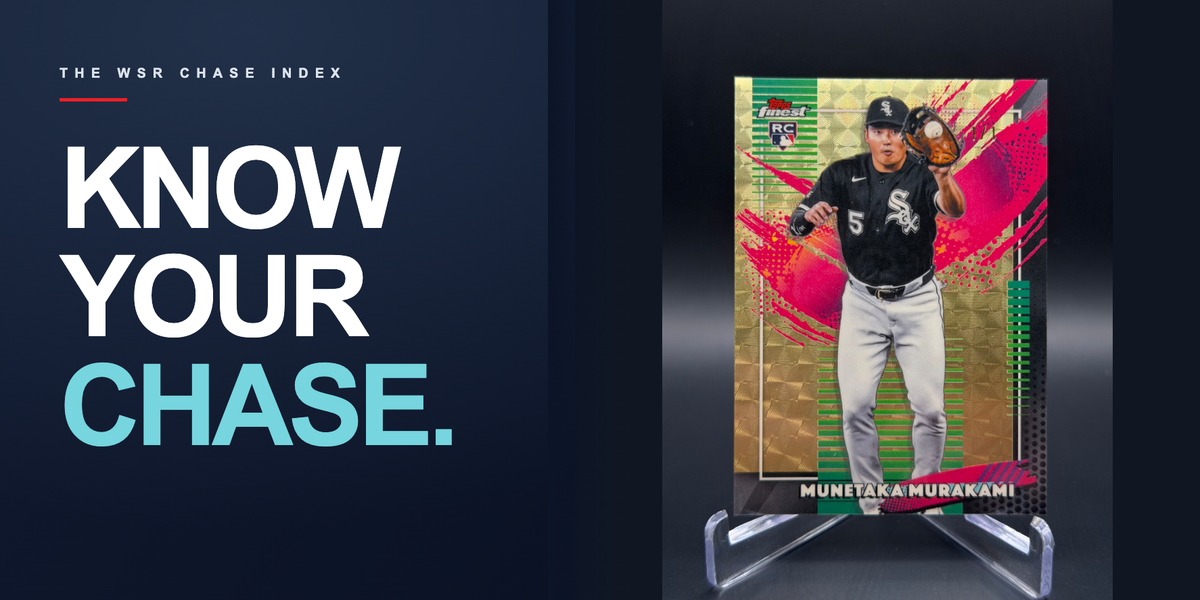
The best part of a break is that moment before the next card turns over.
Maybe you’re chasing your favorite player. Maybe it’s a rookie autograph, a low-numbered parallel, or a card you didn’t know you wanted until you saw it.
That excitement is why we rip. Chase Index is our way of bringing more information into the decision that comes before it: which team do you want?
From a checklist to a clearer picture
A product checklist can contain hundreds of names across base cards, autographs, inserts, and parallels. It’s useful information, but making sense of it takes work.
Chase Index brings checklist information and model-based analysis together to compare teams within a product. It gives collectors a starting point for exploring the players and cards behind each team’s score.
The number opens the conversation. The checklist provides the details.
What the score means
In our current presentation, the highest-scoring team within a product receives a Chase Index of 100. Other teams are shown relative to that leader.
A score of 50 does not mean a 50% chance of pulling a hit. It also doesn’t mean you’ll recover half your purchase price.
Chase Index is a comparative model—not a prediction of what will come out of your particular box or break.
Look beyond the number
When you explore a team, ask what’s driving its score.
Which players appear on the checklist? What autograph sets are represented? Are there particular inserts or parallels you’d be excited to own?
Our scouting reports bring some of that context into the team picker, so you can research a team while keeping your selections in view.
A higher score may catch your attention. A favorite player may matter more to you. Both are useful reasons to take a closer look.
Keep the format in mind
Product format matters when interpreting checklist and odds information. Hobby and other configurations can offer different experiences.
That’s why our analysis includes its format, source date, and model version. When comparing teams, make sure you’re looking at the same product and configuration.
We also distinguish checklist entries from guaranteed cards. A card’s presence on a checklist means it belongs to the product—not that it will appear in your break.
More context for the fun
We built Chase Index to make the research part of collecting easier to explore.
Use it to discover a team you overlooked, investigate a player’s cards, or arrive at a break with a clearer idea of what you’re chasing.
Then enjoy the reveal. That part still belongs to the cards.
Explore the product checklist and Chase Index, then join the WSR Discord to tell us what you’re chasing.
Preview article: prepared to demonstrate the WSR publishing layout. Describes the current Chase Index preview; features and methodology may evolve.
Get new checklists, WSR stories, and break updates by email.
Keep me in the loop →