
Know what you’re chasing—and what it takes to pull it.
Every collector knows the excitement of a big chase. Understanding what’s actually inside a product takes more work: hundreds of players, dozens of parallels, and odds spread across different formats.
We built Chase Index to bring those pieces together. Who can you pull? What makes that particular card interesting? How often might it appear? And how does that change the appeal of a team in your next break?
The goal is to help everyday collectors make more informed choices while keeping the excitement of collecting intact. Your favorite player will always be your favorite player. This gives you more context for the chase.
These four cards show how it works.
← Back to Chase LabSame format. Same box. Four different cards.
All examples use Hobby · 20 packs per box · 12 boxes per case, with hobby adjustments and the buyback option enabled. Calculation date: 2026-10-27. Published odds come from the supplied 2026 Chrome sheet.
Individual-card frequency assumes equally likely subjects across the full checklist family. That is a model assumption, not manufacturer confirmation that every subject appears in every parallel. Private player-rating inputs and weighting stay on the server.
Three numbers to keep separate.
- Player appeal
- The model’s starting assessment of the player. It is not dollars or a grade out of 100.
- Card score
- The appeal of this particular version after card-type, rarity and any buyback adjustments.
- Expected points per box
- The card score multiplied by its estimated copies per box. This is an average contribution, not a payout.
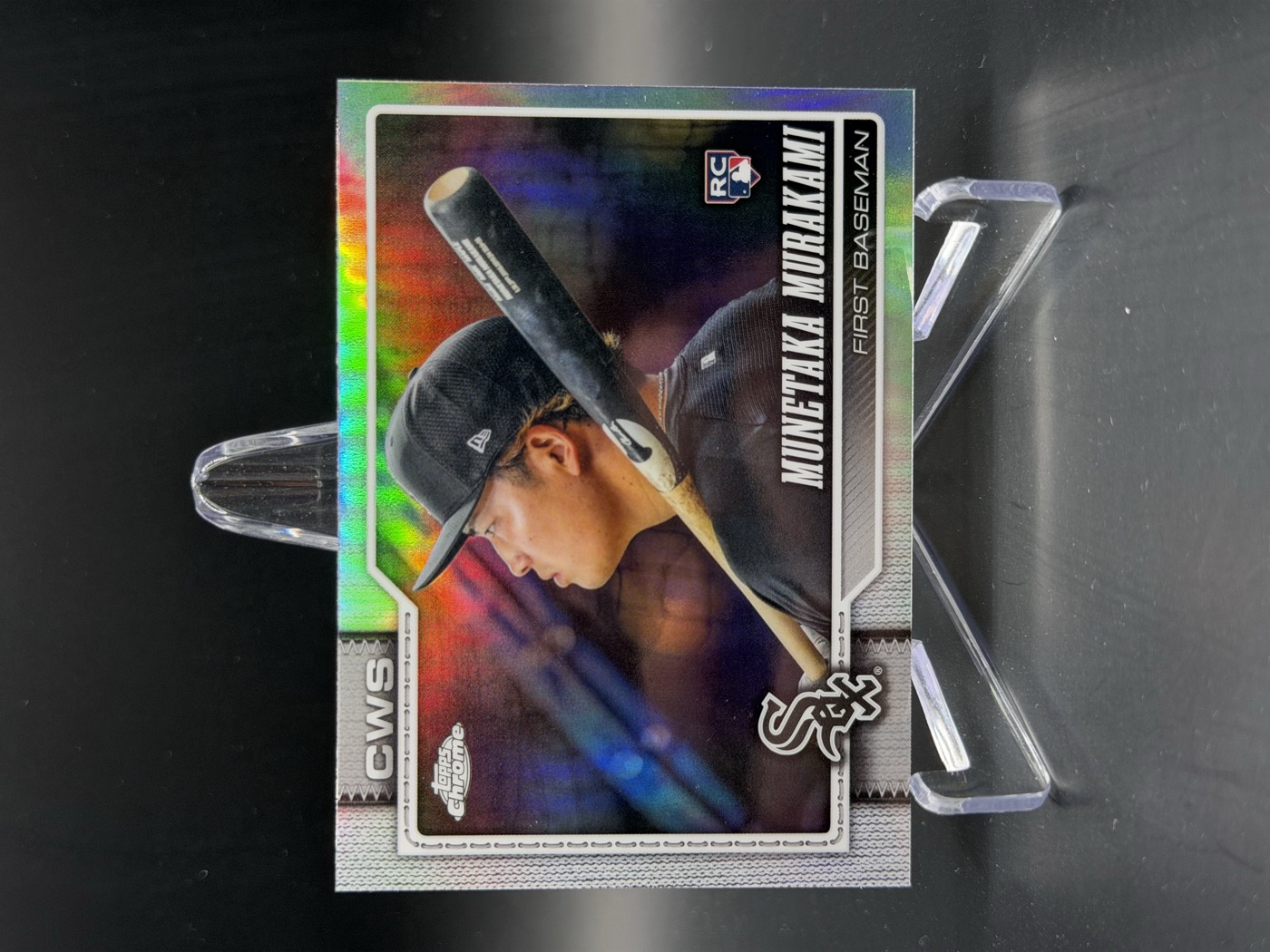
Same player. Different photograph. Different pull.
Munetaka Murakami
Murakami’s Image Variation uses a different photograph from his base card. His player score stays the same, but this version has its own pull odds and rarity adjustment.
- Player appeal
- 40.00
- Card score
- 211.60
- Expected points / box
- 0.82
An established international player can arrive with little MLB history. Murakami’s player score includes a reviewed assessment of his international career and arrival in the hobby.
Follow this card’s calculation
- Start with the selected player score40.00 player appeal points
This is an output of the private player model. We show the value used for this card, not the full rating dataset.
- Score the printing40.00 × 1.00 × 5.29 + 0.00 = 211.60
Player appeal × card type × rarity + extra buyback points. The server rounds scoring terms; visible factors may not reproduce the final digits exactly. No buyback points are added to this card in this snapshot.
- Estimate this specific card’s frequency103 ÷ 20 × 50 = 257.50 boxes
Printing pack odds ÷ packs per box × assumed subject count. This is about one copy per 257.50 boxes on average—not a guarantee by that box.
- Find the expected contribution per box211.60 × 0.00388350 = 0.82 points
The estimated copies per box are 1 ÷ 257.50. Most individual boxes will not contain this card. The contribution joins its team’s other supported cards.
Identify the exact version first. A different image can mean a different odds line—even when the card number is the same.
Find this printing in the checklist ↗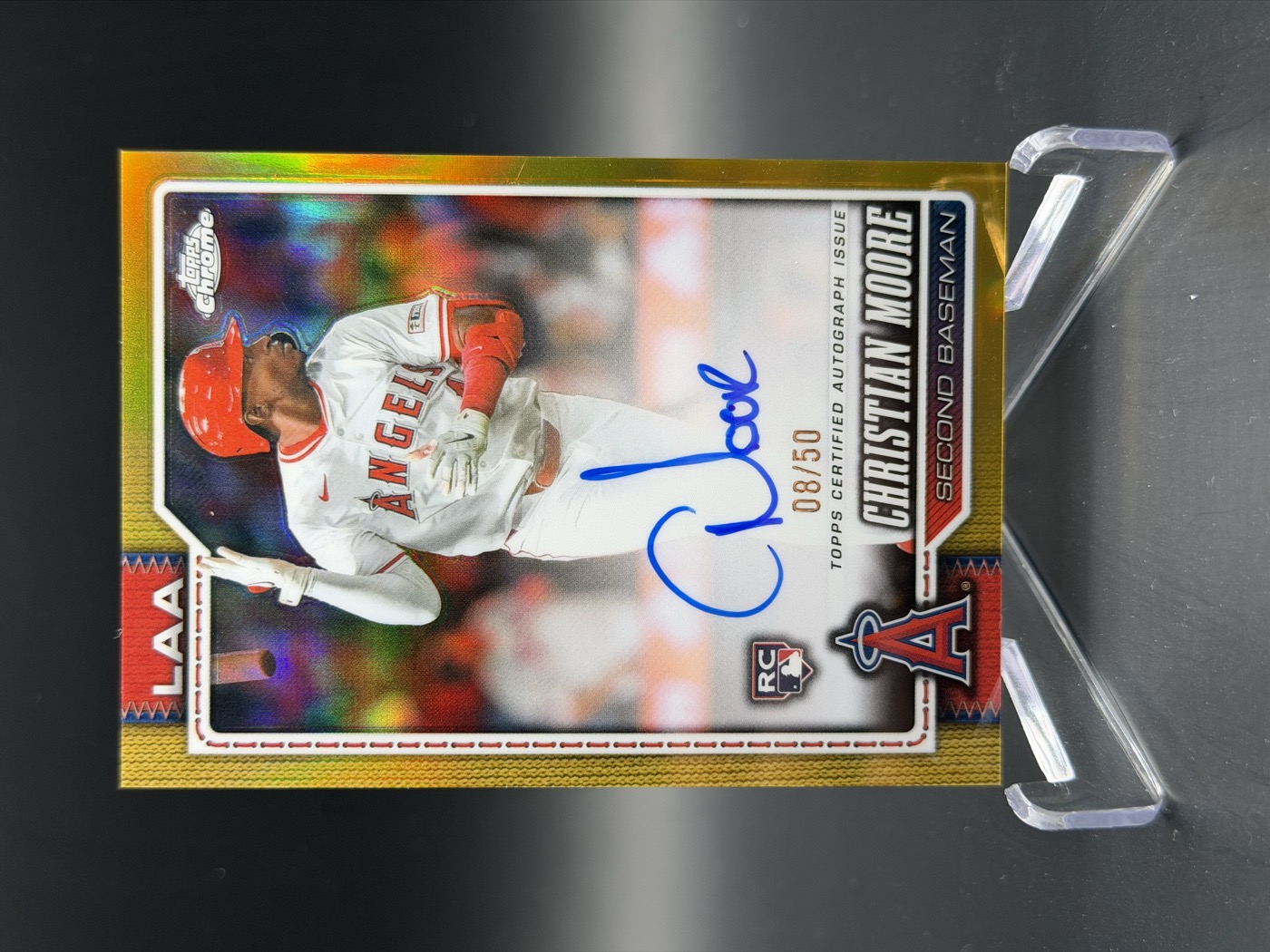
The signature and the gold both matter.
Christian Moore
Moore’s Gold Refractor rookie autograph is numbered 08/50. Start with his player score, apply the autograph adjustment, then account for how difficult this Gold version is to pull.
- Player appeal
- 12.82
- Card score
- 1,182.65
- Expected points / box
- 0.15
The /50 stamp identifies the limited print run. Published Hobby odds tell us how often this version appears in the format we are comparing. We use those odds for rarity, without adding a second bonus for the stamp.
Follow this card’s calculation
- Start with the selected player score12.82 player appeal points
This is an output of the private player model. We show the value used for this card, not the full rating dataset.
- Score the printing12.82 × 6.25 × 14.76 + 0.00 = 1,182.65
Player appeal × card type × rarity + extra buyback points. The server rounds scoring terms; visible factors may not reproduce the final digits exactly. No buyback points are added to this card in this snapshot.
- Estimate this specific card’s frequency1,680 ÷ 20 × 94 = 7,896.00 boxes
Printing pack odds ÷ packs per box × assumed subject count. This is about one copy per 7,896.00 boxes on average—not a guarantee by that box.
- Find the expected contribution per box1,182.65 × 0.00012665 = 0.15 points
The estimated copies per box are 1 ÷ 7,896.00. Most individual boxes will not contain this card. The contribution joins its team’s other supported cards.
A bigger score per card does not automatically mean a bigger expected contribution per box. You also have to account for how rarely it appears.
Find this printing in the checklist ↗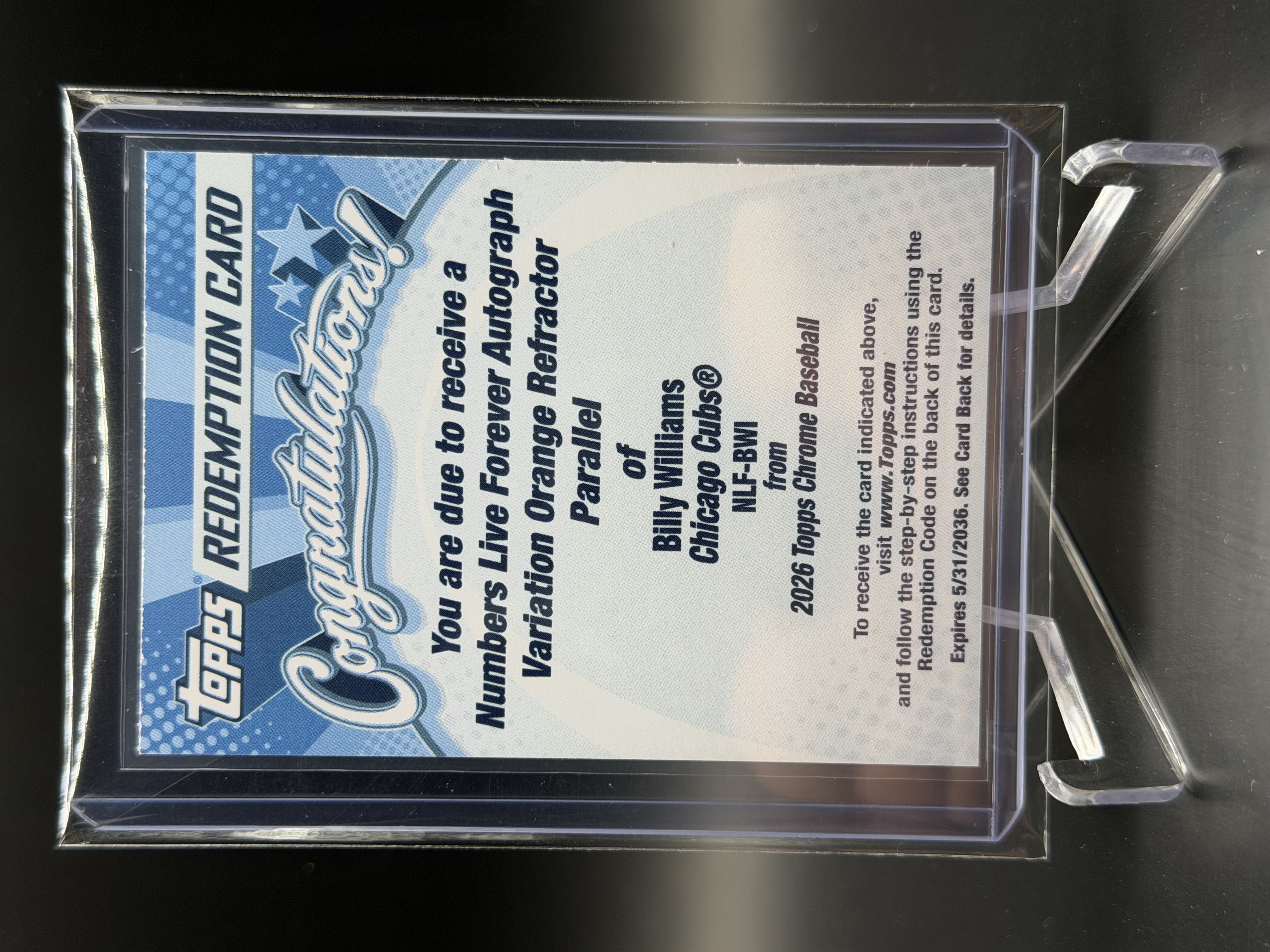
A huge pull can be a tiny part of an average box.
Billy Williams
Williams’s Orange Numbers Live Forever autograph combines an established veteran, a signature and a very rare printing. Together, those factors give it the highest card score of these four examples.
- Player appeal
- 55.97
- Card score
- 6,471.53
- Expected points / box
- 0.39
That high score matters only when you pull it. Multiplying the score by its estimated frequency shows how much this longshot contributes to an average box.
Follow this card’s calculation
- Start with the selected player score55.97 player appeal points
This is an output of the private player model. We show the value used for this card, not the full rating dataset.
- Score the printing55.97 × 6.25 × 18.50 + 0.00 = 6,471.53
Player appeal × card type × rarity + extra buyback points. The server rounds scoring terms; visible factors may not reproduce the final digits exactly. No buyback points are added to this card in this snapshot.
- Estimate this specific card’s frequency167,577 ÷ 20 × 2 = 16,757.70 boxes
Printing pack odds ÷ packs per box × assumed subject count. This is about one copy per 16,757.70 boxes on average—not a guarantee by that box.
- Find the expected contribution per box6,471.53 × 0.00005967 = 0.39 points
The estimated copies per box are 1 ÷ 16,757.70. Most individual boxes will not contain this card. The contribution joins its team’s other supported cards.
The card you most want to pull and the card that contributes most often are not necessarily the same. Expected points keep those two ideas separate.
Find this printing in the checklist ↗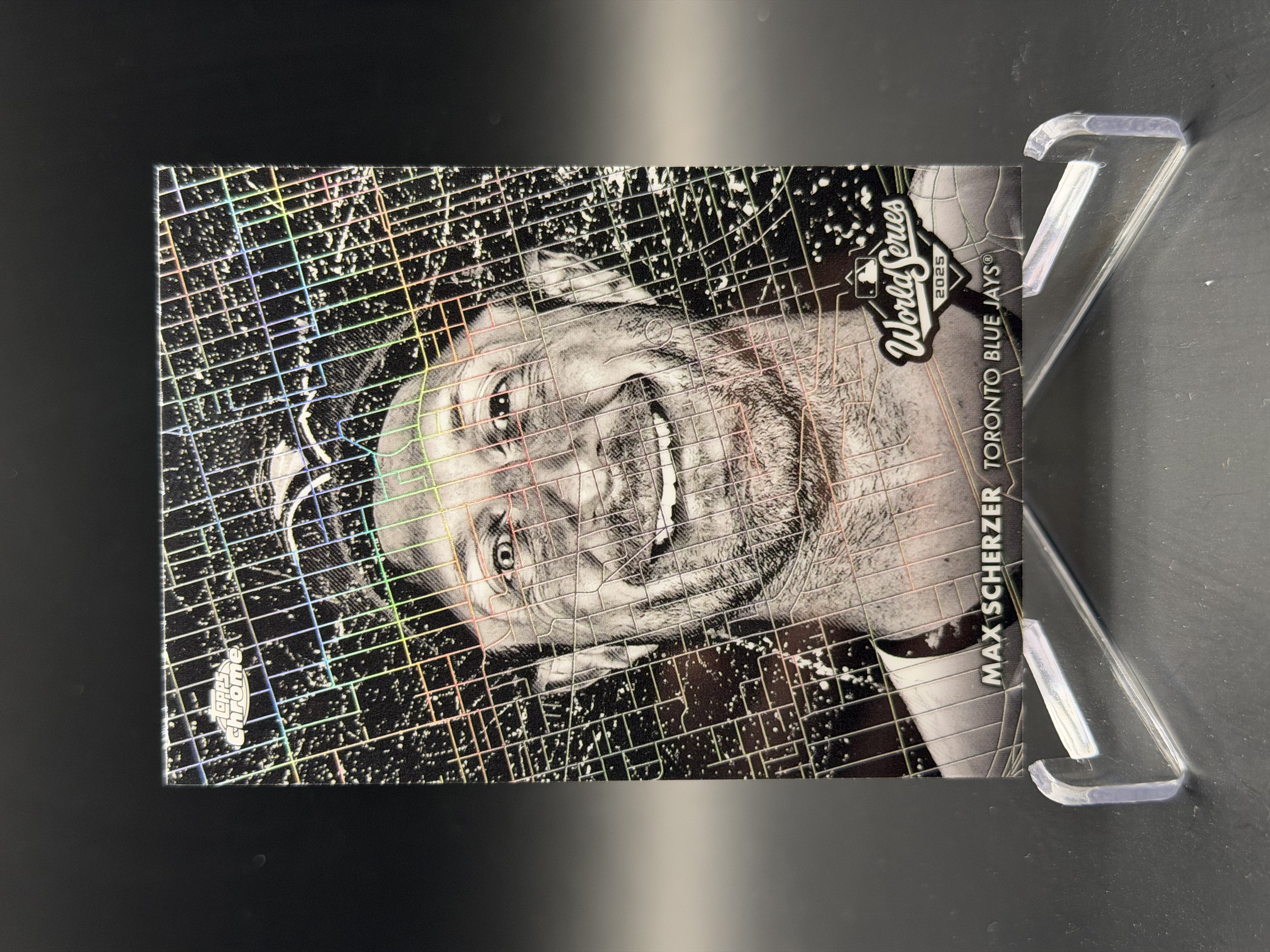
A veteran chase without an autograph.
Max Scherzer
Scherzer’s World Series At Night pairs an established veteran with a case-hit insert. It earns its score through player appeal, card type and rarity—even without a signature.
- Player appeal
- 69.41
- Card score
- 819.68
- Expected points / box
- 0.96
The published odds cover the entire World Series At Night lineup. To estimate your chance of Scherzer specifically, the model divides that frequency across the assumed subject pool.
Follow this card’s calculation
- Start with the selected player score69.41 player appeal points
This is an output of the private player model. We show the value used for this card, not the full rating dataset.
- Score the printing69.41 × 1.56 × 7.57 + 0.00 = 819.68
Player appeal × card type × rarity + extra buyback points. The server rounds scoring terms; visible factors may not reproduce the final digits exactly. No buyback points are added to this card in this snapshot.
- Estimate this specific card’s frequency1,705 ÷ 20 × 10 = 852.50 boxes
Printing pack odds ÷ packs per box × assumed subject count. This is about one copy per 852.50 boxes on average—not a guarantee by that box.
- Find the expected contribution per box819.68 × 0.00117302 = 0.96 points
The estimated copies per box are 1 ÷ 852.50. Most individual boxes will not contain this card. The contribution joins its team’s other supported cards.
Read the actual odds beside the label. A desirable non-autograph can contribute more expected points than a much rarer autograph.
Find this printing in the checklist ↗The biggest card score is not the biggest box contribution.
Williams has the highest individual score among these four. Scherzer contributes more expected points per Hobby box because this printing is estimated to appear more often. That does not make one a better personal collection choice or establish either card’s market price.
| Card | Score per card | Estimated boxes per specific card | Expected points / box |
|---|---|---|---|
| Munetaka MurakamiImage Variation · #274 | 211.60 | 257.50 | 0.82 |
| Christian MooreRookie Autograph · Gold Refractor · RA-CMO | 1,182.65 | 7,896.00 | 0.15 |
| Billy WilliamsNumbers Live Forever Autograph Variation · Orange · NLF-BWI | 6,471.53 | 16,757.70 | 0.39 |
| Max ScherzerWorld Series At Night · WSN-7 | 819.68 | 852.50 | 0.96 |
From these cards to your team.
The model adds the supported contributions assigned to each team, then considers how they are concentrated among card designs. Multi-team contributions split equally. That adjusted score produces the team ranking.
The leader is 100. That is a comparison, not a probability.
An Index of 76 means roughly 76% of the leader’s adjusted score. A 9% score share means 9% of the combined adjusted scores. Neither means 76% or 9% of the cards in your break.
A box, half case and full case offer different chances.
More boxes mean more opportunities. For the Scherzer printing in this example, the model estimates about 0.12% in one Hobby box and 1.40% in a full case. That is different from the team’s chance of pulling any qualifying hit.
Go deeper: expected hits versus chance of at least one
Expected copies = boxes × copies per box. Chance of at least one ≈ 1 − exp(−expected copies). A team with 0.34 expected hits per box has about a 28.8% hit chance—not a promise of a fraction of a card. Across many openings, some boxes contain multiple hits and others none. Actual case collation can differ from this approximation.
Use the evidence—and keep the limits in view.
Hit, Chase and Grail overlap; do not add their percentages. A case-hit label is not a packing guarantee. Missing odds remain unknown. Equal-subject pools and parallel eligibility are assumptions. Numbered stamps are visible evidence, but serial-number scoring refinements are not enabled here. More separate parallels can raise aggregate modeled points under the retained scarcity premium, which is not calibrated to resale prices.